
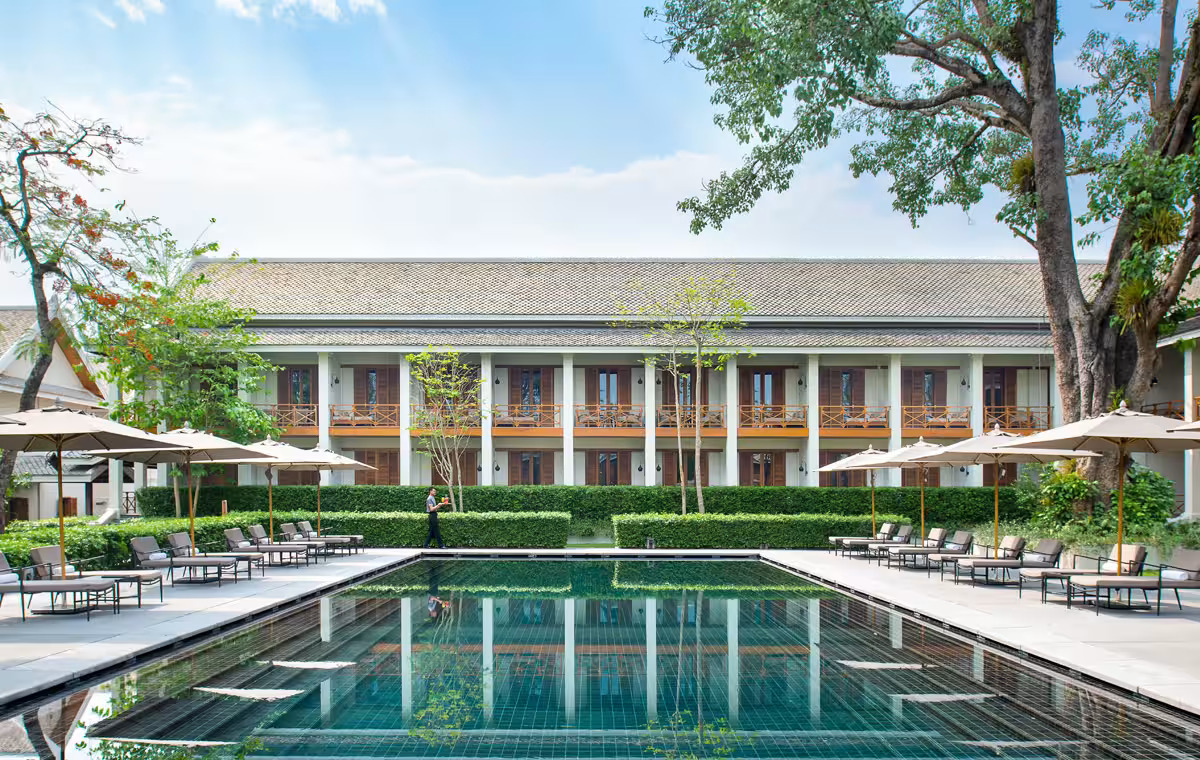
 Luang Prabang rewards those who choose their base thoughtfully — because where you stay shapes everything that follows
Few destinations in Southeast Asia carry the cultural and sensory weight of Luang Prabang. A UNESCO World Heritage city set at the confluence of the Mekong and Nam Khan rivers, it balances ancient temple architecture with a remarkably refined hospitality scene. For travellers asking which resorts in Luang Prabang offer the best views, pools, and amenities, the answer is rarely straightforward — because the city offers two fundamentally different accommodation experiences. City-centre hotels place guests within immediate reach of temples, night markets, and the morning alms-giving ceremony. Riverside resorts, by contrast, trade that proximity for elevated scenery, seclusion, and a more immersive natural setting. This guide examines both options across five key dimensions to help identify which aligns more closely with your travel priorities.
Overview
City-centre hotels in Luang Prabang are concentrated within and around the UNESCO-protected peninsula, offering straightforward access to the city’s principal cultural and culinary attractions. Riverside resorts — many of which are situated along the Mekong or Nam Khan banks, occasionally beyond the immediate town centre — prioritise landscape, tranquillity, and architectural distinction. The two categories serve different expectations, and understanding where they diverge is essential to making a well-considered choice.
| Feature | City-Centre Hotels | Riverside Resorts |
|---|---|---|
| Location | Within or adjacent to the UNESCO heritage peninsula | Along the Mekong or the Nam Khan riverbanks |
| Access to Temples | Walking distance to major wats and alms-giving route | Short ride required for most temple visits |
| Views | Street-level heritage architecture | River panoramas and jungle-framed scenery |
| Pool & Amenities | Varies; often compact due to heritage zoning | Typically more expansive, infinity pools are common |
| Atmosphere | Culturally immersive, active surroundings | Secluded, serene, resort-oriented |
| Dining Access | Night market and restaurants within walking distance | Primarily on-site dining; the town requires transport |
| Value for Space | Moderate; rooms can be compact in older properties | Generally superior space and resort facilities |
| Best For | Cultural explorers, first-time visitors | Relaxation-focused travellers, return visitors |
1. Location and Cultural Access
City-Centre Hotels
The primary advantage of a city-centre hotel in Luang Prabang is immediate, unmediated access to the city’s defining cultural experiences. The alms-giving ceremony, which takes place along Sakkaline Road each morning at dawn, is accessible on foot from most central properties. The same applies to Wat Xieng Thong, the Royal Palace Museum, and the principal night market on Sisavangvong Road. For travellers whose primary motivation is cultural engagement — observing daily monastic life, exploring temple grounds at varying hours, or simply absorbing the rhythm of the UNESCO heritage zone — a city-centre location provides a meaningful advantage that no amount of resort amenity can fully compensate for.
Riverside Resorts
Riverside resorts occupy a different relationship with the city. Many are positioned along the Mekong or Nam Khan banks at a slight remove from the heritage core, which introduces a degree of distance from the cultural landmarks that define Luang Prabang as a destination. Transport to and from the town centre is typically required, either by resort shuttle, tuk-tuk, or private vehicle. For travellers who intend to spend a significant portion of their stay exploring the city on foot, this is a material consideration. That said, several riverside properties maintain close enough proximity to the centre that the inconvenience is minimal, and the trade-off in scenery and atmosphere may well justify the additional short journey.
2. Views, Setting, and Aesthetic Character
City-Centre Hotels
City-centre accommodation in Luang Prabang offers a different kind of visual reward — one rooted in architectural heritage rather than natural landscape. Properties within the UNESCO zone are subject to conservation guidelines that preserve the character of the streetscape, meaning that the surrounding environment itself carries considerable aesthetic value. Views from upper-floor rooms may encompass temple rooftops, the tree-lined boulevards of the old quarter, or the distant hills that frame the city. The setting is intimate and historically layered, which appeals to travellers who find as much pleasure in the built environment as in open vistas.
Riverside Resorts
The scenic advantage of riverside resorts is considerable and, for many travellers, the defining reason to choose them. Properties positioned along the Mekong in particular command views of the river as it moves through the valley, with the forested hills of the opposite bank providing a backdrop that shifts in character across the day and through different light conditions. Infinity pools oriented towards the river are a common feature of the better-regarded properties, and the overall landscape setting is difficult to replicate in a more urban context. For travellers who regard the visual environment as central to the quality of a stay, riverside resorts offer a materially superior experience.
3. Accommodation Quality, Pools, and Amenities
City-Centre Hotels
City-centre hotels in Luang Prabang range from modest guesthouses in converted colonial villas to carefully restored boutique properties with considerable character. The constraints of heritage zoning mean that larger resort-style developments are less common within the protected peninsula, and pool facilities, where present, tend to be compact rather than expansive. The quality of the best city-centre properties is high, and many offer refined interiors with locally sourced materials and considered design. However, travellers whose expectations include full resort infrastructure — spa facilities, large pool terraces, and multiple dining venues — may find the city-centre offering somewhat limited by comparison.
Riverside Resorts
Riverside resorts in Luang Prabang represent the upper tier of the destination’s hospitality offer in terms of facilities and spatial generosity. Properties such as Avani+ Luang Prabang exemplify this category well, combining riverside positioning with contemporary design, well-appointed rooms, and a comprehensive amenities package that includes pool facilities and dining experiences befitting the setting. The additional space available to riverside properties allows for a resort experience that city-centre hotels, constrained by heritage regulations, are seldom able to match. For travellers whose criteria include the quality of the physical property alongside its location, riverside resorts consistently deliver at a higher level.
4. Dining and Evening Experience
City-Centre Hotels
The city-centre location offers a meaningful advantage when it comes to dining variety and the evening experience more broadly. The night market on Sisavangvong Road, the cluster of restaurants along the riverside promenade, and the broader selection of Lao and international cuisine establishments across the heritage district are all accessible on foot. This ease of access encourages exploration and allows travellers to move fluidly between dining options without logistical planning. The ability to extend an evening — to linger over dinner, visit a second restaurant, or stop at a bar on the way back — is a genuine benefit that a city-centre base affords.
Riverside Resorts
Riverside resorts are more self-contained in their dining proposition, with on-site restaurants that are, in many cases, among the better dining experiences available in Luang Prabang. The quality of resort dining has risen considerably in recent years, and travellers who are content to eat primarily within the property will not feel significantly disadvantaged. The consideration arises for those who wish to explore the wider restaurant scene regularly, as doing so requires arranging transport for each outing. This is a manageable inconvenience rather than a prohibitive one, but it does alter the spontaneity with which one can engage with the city’s culinary offerings.
5. Atmosphere and Overall Travel Experience
City-Centre Hotels
Staying in the city centre places travellers in direct contact with the daily life of Luang Prabang in a way that more secluded properties cannot replicate. The sounds of monks moving through the streets at dawn, the activity of the morning market, the gradual quieting of the heritage district after dark — these are experiences that accumulate over the course of a stay and contribute meaningfully to one’s understanding of the city. For first-time visitors in particular, or for those with a strong interest in cultural immersion, the city-centre experience tends to leave a more lasting impression than a stay that is primarily oriented around resort facilities.
Riverside Resorts
Riverside resorts offer a fundamentally different form of engagement with Luang Prabang — one defined by contemplation, natural beauty, and deliberate pace rather than cultural proximity. The experience is best suited to travellers who have either visited before or who are content to engage with the city’s cultural sites selectively rather than comprehensively. For those travelling to Luang Prabang specifically to rest, the riverside setting provides an environment of considerable restorative quality. The combination of river views, well-designed spaces, and a degree of remove from the town’s activity creates conditions that are conducive to the kind of unhurried travel that Luang Prabang, at its best, is well-equipped to support.
Conclusion
City-centre hotels and riverside resorts in Luang Prabang are not competing for the same traveller. The former suits those for whom cultural access, walkability, and immersion in the heritage environment are primary concerns. The latter serves travellers who prioritise landscape, resort amenities, and a more secluded atmosphere, with the city’s attractions available when sought rather than constantly at hand. A clear understanding of one’s own travel priorities — and an honest assessment of how one expects to divide time between the property and the wider city — is the most reliable basis for making the right decision between the two.